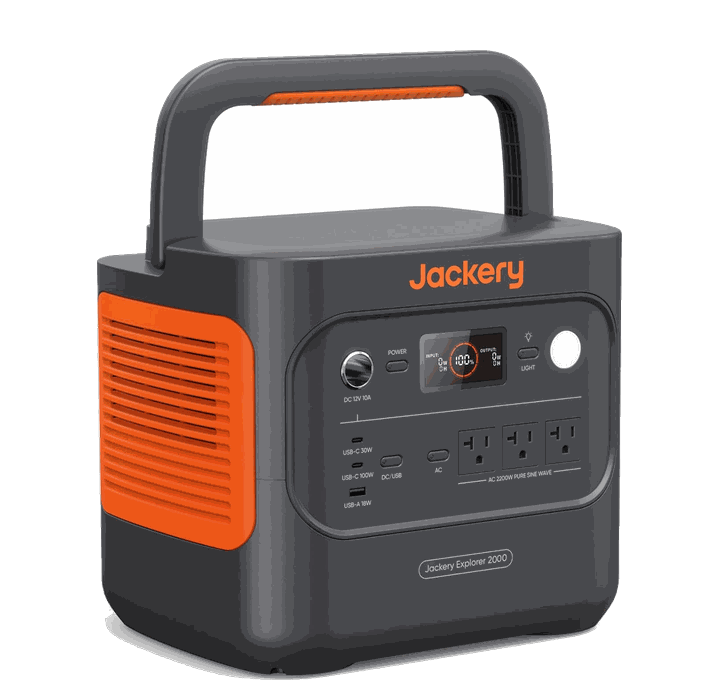
Jackery Explorer 2000 v2
Plain link to Amazon — we currently earn nothing from it. How this works.
What you actually get
Jackery Explorer 2000 v2 is sold as a 2,042 Wh unit, which places it in the over 1,200 Wh band — the size people buy for a fridge through an outage. That figure is the energy in the cells, and it is a true one. It is not what reaches a wall plug.
Between the cells and the outlet sits an inverter that converts direct current to 120 volts alternating current, and it takes its cut — roughly fifteen percent. So the number worth planning around is about 1,736 Wh. The remaining 306 Wh leave as heat and as the inverter's own draw. On this unit that gap is roughly 6 hours of a fridge.
Nobody is misleading you here: the cells really do hold 2,042 Wh. But size this one by the number on the box and you will be 306 Wh short of what you planned for — which you discover at the worst possible moment, not in the store.
What that runs
Working from the usable figure, not the rated one:
| Phone charges | 116 | a 15 Wh phone battery, charged from empty |
|---|---|---|
| Laptop charges | 29 | a 60 Wh laptop battery |
| CPAP nights | 5.4 | a CPAP at 40 W over an eight-hour night, no humidifier |
| Fridge hours | 35 | a full-size fridge: about 150 W while the compressor runs, cycling roughly a third of the time |
These are arithmetic, not measurements. Your own appliances draw what they draw; check the label on the back. Cold weather, a nearly empty battery and high inverter load all cut into the real figure.
Battery: LiFePO4
Jackery Explorer 2000 v2 uses lithium iron phosphate. That is the more durable of the two chemistries in this comparison — typically three thousand or more charge cycles against roughly five hundred for older lithium-ion, plus better heat tolerance. The manufacturer does not state a cycle count.
In practice: charge it once a week and a three-thousand-cycle pack outlives the decade. That is the single biggest difference between two units that otherwise look alike, and it is the one most buyers skip past.
Ports
- 3AC outlets
Counts as published by the manufacturer. Where a figure is missing above, the listing did not state it separately.
The rest of the spec sheet
| Dimensions | 13.2 x 10.4 x 11.5 in | From the Amazon listing rather than the manufacturer — it may describe the packaging. |
|---|---|---|
| Recharge | 66 min | To 80% of capacity. Not scored — makers quote it to different targets, which makes the numbers incomparable. |
| Warranty | 5 years | From the Amazon listing, not the manufacturer's own copy. Worth confirming before you rely on it. |
| App control | yes | The listing mentions app, Wi-Fi or Bluetooth control. |
What we cannot tell you
We have not tested this unit. Everything above comes from the manufacturer's own listing, and a manufacturer's number is a claim rather than a measurement.
For this unit the manufacturer does not publish: surge wattage, cycle life and solar input. Those fields stay empty here rather than being filled with an estimate.
We also cannot tell you how it behaves after two winters, how loud the fan gets under load, or how the support desk responds. Those are the things a real test would cover, and we are not pretending to have done one.
Specifications on this page were last verified against the manufacturer listing on September 6, 2026.
Where it sits in Home backup
Within the home backup class — over 1,200 Wh, built for a fridge through an outage — this unit ranks 4 of 4 on our score. Capacity and continuous output are compared only against other units in the same class, so a compact unit is never punished for being small. How the score works.